Terms of Reference published for the Inspection of the Police Service of Northern Ireland’s use of No File Decision
Published: 25 Nov 2026
Introduction
Criminal Justice Inspection Northern Ireland (CJI) proposes to undertake an inspection of the effectiveness of no prosecution decision-making by the Police Service for Northern Ireland (PSNI), referred to as No File Decision (NFD).
The inspection will assess the effectiveness, governance and oversight of the PSNI’s NFD arrangements, including the strategic and policy framework and the impact of the model on the timeliness, efficiency and quality of case progression. It will also examine outcomes for victims and suspects, with particular focus on how victims’ needs and vulnerabilities are considered and communicated.
Context
Speeding up Justice is a five-year programme of work, led by the Criminal Justice Board, to tackle Avoidable Delay in the processing of criminal cases. It comprises five projects: early engagement; committal reform; remit of the Magistrates’ Court; and digital. In March 2025, the Minister of Justice announced that the early engagement and out-of-court disposals projects would be supported by £20.5 million of transformation funding.[1] This programme was built on work already ongoing, including the PSNI NFD Pilot launched on 29 November 2023. The arrangements were introduced in response to operational pressures, demand on investigative resources and the high level of agreement between previous PSNI no-prosecution recommendations and Public Prosecution Service for Northern Ireland (PPS) decisions.
The NFD arrangements must also be viewed within the context of wider work across the criminal justice system in Northern Ireland to improve timeliness and efficiency. NFD forms part of this wider landscape, seeking to ensure that appropriate lower-level cases which do not meet the Evidential Test for prosecution can be concluded without unnecessary referral to the PPS. Other out of court disposals, such as Community Resolution Notices (CRN), all require the Evidential Test to be met before they are applicable and therefore are not affected by the NFD programme. A recent CJI report was published about the PSNI use of CRN’s and they also form part of the Speeding up Justice programme.[2]
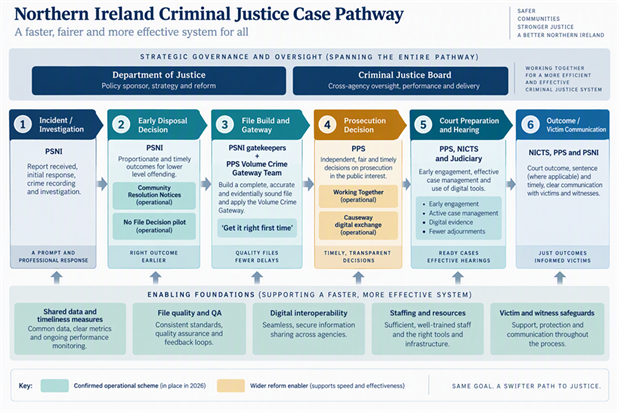
The Speeding up Justice programme is a portfolio of interconnected reforms rather than self-contained programmes within organisations. This is demonstrated in Figure 1 below.
Figure 1: Northern Ireland’s Criminal Justice Case Pathway
The NFD pilot was developed jointly by the PSNI[3] and the PPS[4] and permitted the PSNI to take certain no-prosecution decisions without submitting a prosecution file to the PPS. The PPS were the authority within the Northern Ireland Criminal Justice system who had responsibility for making decisions on prosecutions from files submitted to them by the PSNI and other bodies with powers to investigate. Previously, all cases involving an identifiable suspect and evidence linking that individual to an offence were referred to the PPS who were the responsible authority for making the decision on whether a case would be prosecuted or not. This included those where police assessed that the evidential test for prosecution could not be met.
The pilot authorised police to make NFD within Case Weight categories five to eight. Case Weight categories Five to Eight are the lower level/less serious prosecution caseload and were generally cases directed by Public Prosecutors rather than Senior Public Prosecutors. They span offences from lower-level assault offences through to minor motoring offences; Case Weights one to four encompassed more serious offences and remained subject to PPS decision-making under the NFD arrangements. This scheme includes some domestic abuse related cases and hate crimes if they fall into the agreed lower-level offence range.
In 2022-23, the PSNI submitted a total of 44,130 files to the PPS. Of these 9,086 files recommended No Prosecution, of these 7,217 fell into case weight categories five to eight. A review of the data showed that the agreement rate on No Prosecution recommendations by the PPS was 96%. The agreement rates for domestic abuse and hate crimes were specifically looked at and were similar.
The NFD pilot ended in November 2025, and the scheme continued to operate under the same Terms of Reference with reduced levels of quality assurance. The final evaluation provided a broadly positive evidence base for moving the No File Decision arrangements to full implementation. The principal benefits were a substantial reduction in the time taken to resolve cases where prosecution was not recommended, from a pre-pilot average of 101 days to 43.5 days and a 56% reduction in relevant no-prosecution files being submitted to PPS compared with the pre-pilot period. The agreement on decisions made by the PSNI and the PPS remained high at 95%.
The transfer of responsibility for deciding that certain cases should not be referred to the PPS represents an important exercise of police decision-making and is the first of its kind within the PSNI. It is essential that decisions are appropriate, consistent, adequately supervised and supported by effective governance and quality assurance arrangements.
This inspection will examine whether the NFD arrangements provide an effective and proportionate mechanism for concluding appropriate cases while maintaining the quality of police investigations and decision-making and appropriate safeguards for victims.
Aims of the Inspection
The broad aims of the inspection are to:
- assess the effectiveness of the governance and oversight of the PSNI’s NFD arrangements and determine whether the revised decision-making model delivers appropriate outcomes for victims, suspects and the wider criminal justice system;
- examine the strategic and policy framework applicable to the NFD model;
- examine the level of training and support available to staff working within the PSNI and PPS regarding NFD decision-making;
- examine how the needs, circumstances and vulnerability of victims are considered within the NFD process and if victims are appropriately informed about decisions and rationale, with particular emphasis on victims of domestic abuse and hate crimes;
- Assess/examine the impact of the NFD scheme on the timeliness and efficiency of case progression and if the arrangements are achieving their intended objectives; and
- any other matters arising during the inspection, if considered appropriate by CJI.
Methodology
The inspection will be based on the CJI Inspection Framework. The three main elements of the inspection framework are:
- Strategy and governance;
- Delivery; and
- Outcomes.
Constants in each of the three framework elements and throughout each inspection are equality and fairness, together with standards and best practice. The CJI inspection methodology can be found in The Inspection Process on our website.
Design and Planning
Preliminary research
The documents and assessments of the NFD pilot have been reviewed to assist in informing the scope of this inspection. Meetings have been held with the two key organisations, the PSNI and the PPS to discuss the inspection and its potential themes.
Contact with organisations
Terms of Reference will be shared with the PSNI and the PPS. Liaison Officers from the relevant organisations should be nominated for the purposes of the inspection.
Delivery
Stakeholder consultation
Stakeholder organisations from the voluntary and community sector as appropriate will be consulted and invited to meet with the Inspection Team as part of the inspection. The proposed stakeholders are:
- Women’s Aid Federation Northern Ireland;
- Victim Support Northern Ireland; and
- Commissioner Designate for Victims of Crime in Northern Ireland.
Self-assessment
The PSNI and the PPS will be asked to undertake a self-assessment which will inform decisions on evidence-gathering. Policies and procedures, management information, minutes of meetings and related documentation from the organisations will be requested and examined.
Development of fieldwork plan
Interviews and focus groups will be conducted with the named criminal justice organisations, and relevant stakeholders to give an insight into any issues. The file review process will involve:
- a review of files where the PSNI have made a No File Decision; and
- a review of files sent to the PPS with a recommendation of No Prosecution despite being within the scope of this scheme.
Initial feedback to agency
On conclusion of the fieldwork the evidence will be collated, triangulated and analysed and emerging findings will be developed. CJI will then present the emerging findings to the inspected organisations.
Drafting of report
Following completion of the fieldwork and analysis of data, a draft report will be shared with the inspected organisations for factual accuracy check. CJI will invite the inspected bodies to complete an Action Plan within six weeks to address the recommendations and if the plan has been agreed and is available, it will be published contemporaneously with the final Inspection Report. The Inspection Report will be shared, under embargo, in advance of the publication with the inspected organisations.
Publication and Closure
A report will be sent to the Minister of Justice for permission to publish. When permission is received the report will be finalised for publication. A press release will be drafted and shared with the inspected organisations prior to publication and release. A publication date will be agreed, and the report will be issued.
Indicative Timetable
- Scoping/Research: October 2026
- Terms of Reference published and shared with inspected organisations: November 2026
- Stakeholder consultation: November to December 2026
- Agency fieldwork: January to March 2027
- Draft Report to agencies: May 2027
- Factual accuracy feedback received: June 2027
- Publication: September 2027
The above timetable may be impacted by factors outside CJI’s control. The inspected organisations will be kept advised of any significant changes to the indicative timetable.
[1] Department of Justice, Transformation projects will deliver tangible benefits for Justice, available at: https://www.justice-ni.gov.uk/news/transformation-projects-will-deliver-tangible-benefits-justice
[2] CJI, Community Resolution Notices, available at https://www.cjini.org/reports/police-use-of-community-resolution-notices/.
[3] PSNI, No File Decision Pilot, available at https://www.psni.police.uk/safety-and-support/advice-and-information/victim-support/no-file-decision-pilot.
[4] PPS, Pilot file submission arrangements between PPS and PSNI, available at https://www.ppsni.gov.uk/pilot-file-submission-arrangements-between-pps-and-psni.

Stay up to date with CJI’s latest news
Sign up to our newsletter to get regular updates from us delivered directly to your inbox.